The call came shortly after the building opened for the morning. Overnight rain had passed through the area, and now a ceiling tile near the back of the commercial space carried a dark, unmistakable stain. A few drops had reached the floor. It wasn’t a disaster, but it was enough to make the facility manager look upward and ask the question every property owner eventually asks: How serious is this?
What followed is an illustrative scenario, not a specific Higher Level Roofing customer project. But the sequence is familiar across commercial properties with aging low-slope roofs. A seemingly simple leak can become the starting point for a much broader conversation about Commercial Built-Up Roofing, roof condition, drainage, maintenance, and whether another patch is really the right answer.
At first, though, nobody was thinking about roofing strategy. They simply wanted the water to stop.
Stage One: A Small Leak Raises a Larger Question
By midmorning, the rain had ended. From inside the building, the problem appeared straightforward: one stained ceiling tile, one damp area, one suspected leak somewhere directly overhead.
But commercial roofs rarely make diagnosis quite that convenient. Water can enter through one location and travel within the roofing assembly or along building components before appearing indoors. The stain tells you that water reached the interior. It doesn’t necessarily tell you where the journey began.
The roof inspection therefore started with the surrounding area but quickly expanded. Nearby penetrations were examined. Flashing conditions were reviewed. Drainage pathways were checked. Previous repairs became part of the investigation.
That last detail mattered. This wasn’t the first time the roof had required attention.
“One leak may be a repair. A pattern of leaks is a reason to start asking questions about the entire roof.”
Records showed that localized repairs had been completed in several areas over time. None of them alone proved that the roof required replacement, but together they changed the nature of the conversation. The facility manager was no longer asking only, “Can we fix this leak?”
The better question became: What is the roof trying to tell us?
Stage Two: Looking Beyond the Visible Damage
The next stage was less dramatic but far more valuable. Instead of focusing exclusively on the latest water stain, the evaluation widened to include the roof field, drains, flashing, penetrations, perimeter conditions, rooftop equipment, and accessible portions of the existing assembly.
Some areas appeared serviceable. Others deserved closer attention. The important discovery wasn’t a single spectacular failure; it was the broader context created by multiple conditions and an accumulated repair history.
That context allowed three possible paths to be discussed.
A localized repair could make sense if deterioration proved limited and the surrounding assembly remained suitable for continued service. Restoration might deserve consideration if broader surface conditions could be addressed while the underlying roof remained an appropriate candidate. Replacement would become more compelling if deterioration or moisture-related concerns proved sufficiently widespread that continued repairs no longer offered a sensible long-term strategy.
For the first time, the decision wasn’t being driven by the urgency of the latest leak.
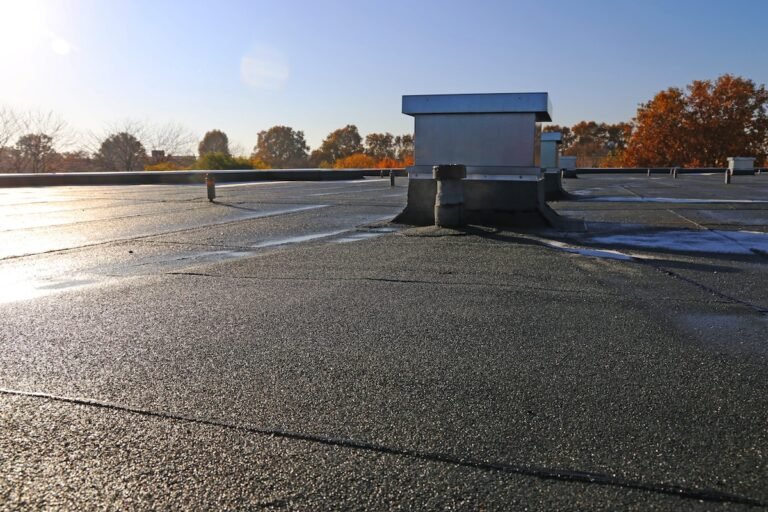
Drainage became an especially important part of the assessment. Commercial roofs often look flat from the ground, but low-slope systems depend on deliberate water movement toward drains and scuppers. Areas where water remains longer than intended, blocked drainage points, or poorly performing transitions can place additional demands on the roofing assembly.
The team also looked at how the roof was actually used. HVAC equipment required regular servicing, which meant technicians crossed certain areas repeatedly. Past mechanical work had introduced penetrations and repairs. The roof wasn’t merely exposed to weather; it was part of an active commercial building.
Stage Three: Why a Multi-Layer System Enters the Conversation
Once the broader conditions were understood, attention turned toward potential roofing systems. This was an important sequence: the material wasn’t selected first and then justified afterward. The building established the requirements, and the roofing options were considered against them.
Single-ply membranes such as TPO, PVC, and EPDM could all enter a modern low-slope roofing discussion depending on project conditions. Built-up roofing offered another approach—one based on multiple reinforcing plies incorporated with bituminous materials to create a layered waterproofing assembly.
For this illustrative building, that concept deserved serious consideration. The property manager valued a substantial multi-ply approach, and the building conditions allowed the project team to evaluate BUR alongside other appropriate Heavy-Duty Roofing Systems.
What made the conversation interesting wasn’t simply that built-up roofing had been used for generations. Tradition alone wasn’t persuasive enough. The attraction was the logic of the assembly itself: multiple integrated layers, appropriate protective surfacing, and a system that could be designed around the particular conditions of the property.
“The right commercial roof isn’t the system with the longest history or the newest technology. It’s the one whose strengths correspond to the building beneath it.”
The decision was beginning to take shape. But choosing the system was only the midpoint of the story. The next question was more demanding: How would all of those materials become one dependable roof?
Stage Four: Building the Roof from the Bottom Up
The installation plan began with what would eventually disappear from view. Existing conditions had to be addressed, the substrate prepared appropriately, and the specified roof assembly coordinated with insulation, drainage, penetrations, perimeter details, and rooftop equipment.
Then the built-up system began taking form. Reinforcing plies and bituminous materials were incorporated according to the specified assembly, gradually creating the multi-layer waterproofing construction that had first been discussed during the evaluation.
From the parking lot, very little about the building seemed to change. Up on the roof, however, each stage depended on the quality of the stage before it. A problem hidden beneath subsequent layers would not become less important simply because it could no longer be seen.
That was particularly true around the complicated areas. Drains had to remain part of a deliberate water-management strategy. Penetrations and equipment curbs required careful transitions. Perimeter conditions and flashing needed the same attention as the broad uninterrupted roof field.
The project was no longer about replacing an old surface. It was about resolving the roof as one complete system.
Installation logistics mattered too. This was still an operating commercial property. Employees arrived each morning, mechanical systems continued running, and normal business couldn’t simply disappear while roofing work took place overhead. Access, staging, rooftop activity, and communication therefore became part of the project rather than secondary concerns.
“Commercial roofing happens above a business that still has customers, employees, equipment, and schedules. A successful installation protects operations as carefully as it protects the building.”
Eventually, the final sections were completed. The visible work slowed, equipment was removed, and the roof settled into the role it had been designed to perform.
But the story wasn’t finished.
Stage Five: The First Storm Is Not the Finish Line
Weeks later, another weather system moved through. Rain crossed the roof, followed the designed drainage pathways, and disappeared toward the outlets. Inside, the facility manager walked past the same area where that first stained ceiling tile had started the entire conversation.
This time there was no dramatic moment. And that was precisely the point.
The more meaningful change wasn’t simply the absence of an immediate problem. The property now had a clearer baseline for future roof management. Project documentation could be retained. Inspections could begin from a known condition. Drainage, flashing, penetrations, and high-traffic areas could be monitored deliberately instead of receiving attention only after water reached the interior.
A new roof had created an opportunity for a new maintenance habit.
The facility manager’s role changed as well. Instead of viewing the roof primarily as something that demanded attention when it leaked, the roof could now be treated as a building asset whose condition deserved regular observation.
Future HVAC servicing would still occur. Storms would still pass over the property. Materials would still experience weather and ordinary aging. No responsible roofing strategy could promise otherwise.
What could change was the response. Developing conditions could be documented earlier. Drainage pathways could be kept clear. Rooftop work could be tracked. Compatible repairs could be made before small defects became larger disruptions.
And that brings the story back to the first morning.
A stained ceiling tile had initially looked like the entire problem. In reality, it was only the visible end of a much longer chain of questions. Where had the water entered? Why were repairs recurring? What was happening across the broader roof? Could the existing system continue to be repaired? Would restoration work? Was replacement justified? And if it was, which roofing approach actually belonged on the building?
The value of the process was not that built-up roofing emerged as an automatic winner. It was that the final system was considered only after the building had been understood.
“Sometimes the most important roofing project begins with a bucket on the floor—and ends with a completely different way of managing the building above it.”
Months and years later, the roof will continue its quiet work while business happens beneath it. Inspections will become part of the calendar. Mechanical technicians will return. Drains will need attention. Repairs may eventually become necessary.
But now those events belong to a plan rather than a cycle of surprises.
What began as a small leak became something more useful: a reason to stop reacting to the roof and start understanding it.